If you work in composite manufacturing, you have almost certainly come across the term filament winding machine — but what exactly is it, how does it work, and how do you know which type is right for your application?
This guide answers all of those questions, covering the complete filament winding process, the different machine types available, and how to choose the right one for your production needs.
What Is a Filament Winding Machine?
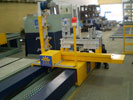
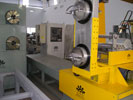
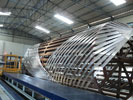
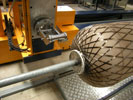
A filament winding machine is a manufacturing system that winds continuous reinforcement fibres — typically glass, carbon or aramid — onto a rotating cylindrical mould called a mandrel. The fibres are drawn through a resin bath to wet them with resin, then laid down in precise geometric patterns as the mandrel rotates and a carriage moves the fibre delivery eye back and forth along its length.
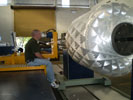
Once all the layers have been wound to the required thickness, the part is cured — either in an oven or at room temperature depending on the resin system — and the mandrel is removed to leave a hollow, high-strength composite structure.
The key word here is precision. Every modern CNC winding machine works on this principle — mandrel rotation speed, carriage travel rate and winding angle are all programmed in advance and executed by computer control. This is what allows manufacturers to produce complex composite components that are identical from one production run to the next.
Why Is Filament Winding Used?
Filament winding is used wherever engineers need a lightweight structure that can handle high pressure, high stress or aggressive chemical environments — without the weight or cost of metal.
The process gives manufacturers precise control over fibre orientation, which means the mechanical properties of the finished component can be optimised for exactly the loads it will face. A pipe that needs to resist internal pressure gets more hoop-wound layers. A pressure vessel end cap that needs to handle axial loads gets polar-wound fibre over the dome. A structural tube for an aircraft gets a carefully engineered combination of both.
This level of control, combined with the ability to automate the process and produce consistent results at volume, is why filament winding has become the dominant manufacturing method for composite cylinders, pipes, tanks and tubular structures across dozens of industries.
Types of Filament Winding Machines
Not all filament winding machines are the same. The number of axes a machine controls determines what it can produce.
- 2-axis: the simplest and most common configuration. It controls mandrel rotation and carriage travel, and is well suited to straightforward cylindrical components — pipes, rollers, and basic pressure vessels. It is the most cost-effective entry point into filament winding.
- 3-axis: adds a cross-feed axis, which gives the delivery eye more freedom of movement and allows the machine to wind tapered components or vary the winding angle more precisely along the length of the mandrel.
- 4-axis: adds rotation of the delivery eye itself, which is what enables polar winding — the fibre pattern that passes over the end caps of a closed vessel. This is essential for gas cylinders, CNG tanks, hydrogen storage vessels and aerospace pressure vessels.
- 5-axis and 6-axis: offer the greatest freedom, allowing winding on non-cylindrical geometries and enabling the most complex composite structures used in aerospace and defence applications.
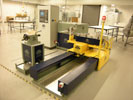
Finally, a lab winder is a compact filament winding machine designed for R&D environments, universities and small-batch prototype production. It replicates the full winding process at a smaller scale, making it ideal for material testing and process development.
How to Choose the Right Filament Winding Machine
The right machine depends on three things: the components you need to produce, the volume you need to produce them at, and the budget you have available. Understanding filament winding machine price ranges across different axis configurations will help you set realistic expectations before you start evaluating suppliers.
For standard cylindrical components at high volume — pipes, tanks, rollers — a 2-axis machine is usually the right choice. It is simpler to operate, easier to maintain and more cost-effective than machines with more axes.
If you are producing closed-end pressure vessels, CNG cylinders or anything that requires winding over the domes, you need at least a 4-axis machine.
If you are in R&D or producing prototype components in small batches, a lab winder gives you the full filament winding capability in a compact, cost-effective package, and can be paired with a range of filament winding accessories to extend its capability across different resin systems and fibre types.
If your components have complex geometries — non-cylindrical structures, variable cross-sections or demanding aerospace specifications — a 5 or 6-axis machine gives you the freedom to produce them accurately.
The best approach is always to start with your component requirements and work backwards to the machine specification. At CNC Technics, we offer free consultations to help manufacturers work through exactly this process.
What to Look for in a Filament Winding Machine Supplier
Once you know what type of machine you need, the supplier you choose matters as much as the machine itself.
Look for suppliers with genuine application expertise in composite manufacturing — not just CNC engineering. The best filament winding machine suppliers understand fibre mechanics, resin systems and winding path design, and can help you optimise the machine for your specific components.
Make sure full installation and commissioning is included in the supply package. A filament winding machine needs to be properly installed, calibrated and validated before you can run production — this should not be an optional extra. Reviewing a supplier's track record of filament winding machine installations is one of the best ways to judge their real-world experience.
Check the after-sales support offering carefully. A filament winding machine will be in your production line for 10 to 20 years. Spare parts availability, response times and the ability to get technical support quickly all matter enormously over that timeframe.
CNC Technics supplies filament winding machines from 2-axis through 6-axis configurations, with full installation and commissioning support and genuine spare parts backed by long-term after-sales service across India and internationally. Contact us to discuss your requirements.
⬅ Back to Blog