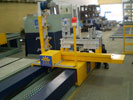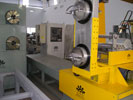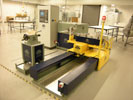
If you have been looking into equipment for composite manufacturing, you have probably come across the term CNC winding machine. But what exactly does CNC mean in this context, how does it change the way the machine works, and does it actually make a meaningful difference to what you can produce?
This article explains it clearly — including how CNC control fits into the broader filament winding process.
What Is a CNC Winding Machine?
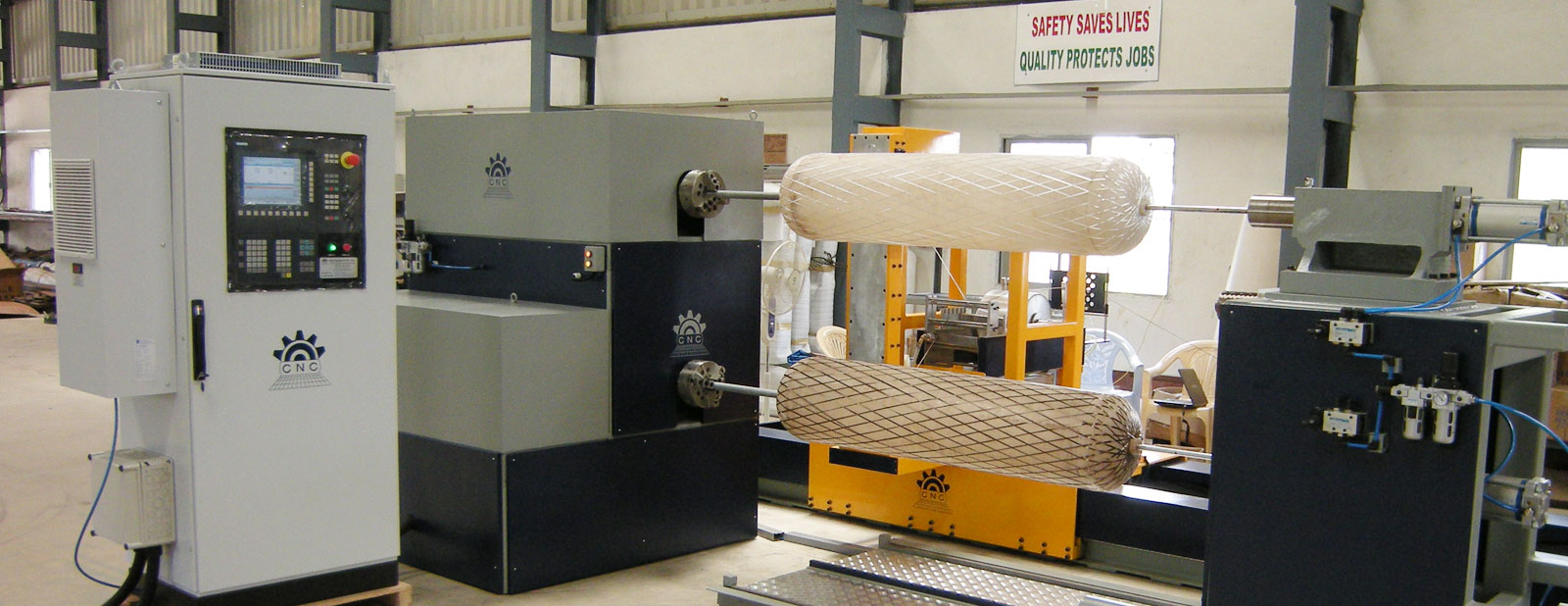
CNC stands for Computer Numerically Controlled. A CNC winding machine is a filament winding machine where every axis of movement — the mandrel rotation, the carriage travel, the delivery eye position and angle — is controlled by a computer program rather than by mechanical cams, gears or manual adjustment.
This might sound like a small technical distinction, but it changes almost everything about how the machine works and what it can produce.
On a traditional mechanically-controlled winding machine, the winding pattern is determined by the physical setup of the machine — the gear ratios, the cam profile, the carriage speed. Changing the winding pattern means physically changing the mechanical setup, which takes time and limits flexibility significantly.
On a CNC winding machine, the winding pattern is a program. You write the program, load it into the controller, and the machine executes it exactly. Changing the winding pattern means writing a new program — which can take minutes, not hours.
How a CNC Winding Machine Works
The core of a CNC winding machine is its motion control system. The controller coordinates the movement of multiple axes simultaneously to produce the desired winding pattern on the mandrel surface.
The main axes are the spindle, which rotates the mandrel, and the carriage, which moves the fibre delivery eye back and forth along the mandrel length. These two axes working together in a precisely calculated ratio determine the helix angle at which the fibres are laid down.
On more advanced machines, additional axes add further degrees of freedom. A cross-feed axis allows the delivery eye to move perpendicular to the carriage travel, giving finer control over fibre placement on tapered or complex mandrel profiles. A rotary delivery eye axis allows the angle of the eye itself to be varied, which is essential for polar winding on closed-end vessels.
The CNC controller reads the winding program — typically generated by specialist winding path software such as CADFIL software — and translates it into coordinated movement commands for all axes simultaneously. The result is precise, repeatable fibre placement that matches the programmed design exactly.
What Makes CNC Winding Machines Better Than Traditional Systems?
The advantages of a CNC winding machine over a traditional mechanical system are significant, and they compound over time in a production environment.
Flexibility is the most obvious one. Because the winding pattern is a program rather than a mechanical setup, you can switch between different components quickly and reliably. A CNC winding machine that produces pipes in the morning can be set up to wind pressure vessel bodies in the afternoon. On a mechanical machine, that kind of changeover takes far longer.
Repeatability is equally important. Every component wound on a CNC machine is wound to exactly the same program. The fibre angles, the layer sequence, the tension profile — all of it is identical from the first component to the thousandth. This is what makes CNC winding machines suitable for aerospace and defence applications where component consistency is a certification requirement.
Process monitoring is another significant advantage. Modern CNC winding machines can log data throughout the winding cycle — mandrel speed, carriage position, delivery eye angle, winding tension — providing a complete production record for every component. This matters increasingly in regulated industries where traceability is required.
Finally, the ability to optimise winding patterns through software means that CNC winding machine users can continuously improve the structural performance of their components without physically modifying the machine — often with the help of filament winding accessories that extend the machine's capability across different resin systems and fibre types.
Which CNC Winding Machine Is Right for Your Application?
The right CNC winding machine depends on the components you need to produce. The key decision is axis count.
Two-axis machines are the right choice for standard cylindrical production — pipes, tanks, rollers — where the winding geometry is relatively simple and production volume is the priority.
Four-axis machines are needed for closed-end vessels where the fibre needs to wrap over the polar openings. If you are producing gas cylinders, CNG tanks or aerospace pressure vessels, four axes is the minimum you need.
Five and six-axis machines are for the most demanding applications — complex non-cylindrical structures, highly optimised fibre paths and advanced aerospace components.
Beyond axis count, the quality of the CNC control system, the winding software compatibility, the rigidity of the machine structure and the supplier's application knowledge all matter significantly — as does understanding CNC winding machine price differences across configurations before you start comparing suppliers.
CNC Technics manufactures CNC winding machines from 2-axis through 6-axis configurations for composite manufacturers across India and internationally. You can see CNC winding machine photos in our gallery, or contact our engineering team to discuss your application.
⬅ Back to Blog